Sunday, January 28, 2007

The Anniversary

Two graves must hide thine and my coarse,
If one might, death were no divorce...
John Donne, "The Anniversarie"

To celebrate the first anniversary of my dad's death, I did something that he would have strongly disapproved of: I began therapy. For the entire year, I'd been confronted again and again by how much I needed to do this, and I saw, in candid moments, that I was a textbook case for clinical depression. But--and this is a big part of the problem--I am my father's daughter, meaning that I am stubborn as hell about repressing emotion and rationalizing bad behavior. And I told myself these things: you are cynical about life, yes; a pessimist, absolutely. These are aspects of your personality that you need to embrace, not symptoms of a disease that needs to be eliminated.

But a few weeks ago, as the anniversary crept closer, I decided that if I couldn't call myself out on this shit, I needed to pay someone to do it for me. I wasn't sleeping well, but I didn't want to get out of bed. I resumed my obsession with death. I began to believe, again, that the world is controlled by raving maniacs, who are in turn controlled by a maniacal God. My heart raced frantically, hamster-like, in my chest. Personality? God, I hope not.

So, off I went to a really great therapist who plays the part exactly like I want him to. He pays close attention to semantics, asking challenging questions about my word choices as I try to explain the past. And, we've even talked theory: he's a cognitive psychologist, and he's explained exactly what that means and how he wants that approach to play out for me. Which is great, because it allows me to believe that the whole therapy process is at least somewhat within my own control.

Strangely, even though I avoided this for so long, I'm starting to like it. Maybe this is because I'm an egomaniac and love discussing myself for a hour; maybe it's because I'm actually making sense of some aspects of my past. But one thing continues to nag me: what ARE the boundaries between my depression and my personality? And, furthermore, what if the world actually IS run by maniacs? Wouldn't it be better for me to accept this? What if I'm being a realist, something that naive optimists choose to call depression?

Mike tells me this is my depression talking.

Wednesday, January 10, 2007

Eating alone

A woman eating alone in a "sit-down" restaurant is an unusual thing, even in the twenty-first century. I realized this a few years ago, when I would occasionally eat out alone. Most of the time, I would come prepared to look busy, brandishing a book or magazine like a weapon of sorts against the confused and/or pitying gaze of the waitress. But honestly, I don't like to read while I'm eating; I don't like to talk much, either. I just want to focus on the fleeting pleasure of hot, flavorful food, freshly delivered from the kitchen: the way it looks on the plate, the way it smells, and of course, the way it tastes. In fact, one of my favorite moments in everyday life is when a plate of food is placed in front of me. (If you've met the people who raised me, this should come as no surprise.) I don't need a partner to enjoy this moment, even if I am a woman.

Since I got married, I don't eat at restaurants alone all that often. Eating is one of the most fundamental activities of life, so if you're truly sharing your life with someone, it goes without saying that you'll eat with them most of the time. Last Saturday, however, I found myself alone, and knew exactly what I wanted to do: eat lunch at Lulu's Noodles and then spend the afternoon at the Carnegie Museum. So, I went to Lulu's, announced to the host that I was a party of one, and was given the worst table in the entire place, which I'm sure they were saving for a solitary party such as mine. I resisted the urge to get out a suitable person-dining-alone activity, and instead simply sat and (i'm pretty sure) blatantly stared at the people around me, eavesdropping on their innane conversations. It was great. Then, my green tea and pad thai arrived, and I savored the moment as long as I could.

Alone, and without the self-imposed distraction of a book, the moment was heightened: I dwelled upon the well-balanced flavors and textures, the heat on my tongue. I ate so slowly and deliberately that I couldn't finish the generous helping, as I usually can. My meal, along with the gray afternoon light on the table and the clamor of eating all around, formed a sort of still-life in my head, and as I walked through the art galleries later, I wished that I could bring myself to paint it. But I don't paint anymore, so I'll use Li-Young Lee's words to represent the subdued pleasure of eating alone I experienced that day:

White rice steaming, almost done. Sweet green peas
fried in onions. Shrimp braised in sesame
oil and garlic. And my own loneliness.
What more could I, a young man, want?


Sunday, December 31, 2006

A Holiday


Tonight is New Year's Eve, which is my absolute LEAST favorite holiday, because it's all about SOCIALIZING and having a "great" time, when really, there's nothing all that great about talking to shallow strangers at drinking parties in expensive hotel rooms, which is what most people think they need to do to have a great time on New Year's. There's also nothing great about being suckered into attending a drinking party at a near-stranger's house, which has been the story of my New Year's Eve for the last three years or so. All I remember doing at one of these parties is staring like a zombie at re-runs of "I Love the Eighties" on VH1 while drinking warm Coors Lights. At another, I fell asleep. At another, I became irrationally angry when our friend Ashley repeatedly and loudly insisted that we play charades, my absolute LEAST favorite game--so angry, in fact, that I yelled at her. When we finally wound up playing anyway, despite (or because of?) my evident hatred of the game, I became overly and embarrassingly competitive as an outlet for my aggression. I wrote down obscure, oddly worded book and film titles for the other team to act out; in revenge, someone gave me The Silmarillion. Luckily, Darren Belajac (another overly competitive player) was on my team and guessed it.

This year, I'll be going back to a near-stranger's (friend-of-a-friend's) house for a drinking party where games will be played. Seems like a cruel repetition of past New Year's nightmares, but this time, there are two differences: we're bringing our own supply of Jagermeister and Goldschlager, and I've changed my mind about games. They're pretty fun, especially when you have nothing more to talk about, which happens quite frequently to socially awkward people like myself. During my Mom and Grandma's five-day stay in Pittsburgh over Christmas, for instance, we played Skip-bo and Monopoly, thereby avoiding hours of awkward and meaningless chatter. Because who wants to discuss real-life with your family when you could be talking about purchasing the Pennsylvania Railroad or Park Place? Certainly not me.

Unfortunately, the dreaded real-life discussions do come up eventually. My mom started missing my dad when we sat down to eat Christmas dinner, and I spent a large part of the evening counseling her while trying to subvert my own emotions on the subject. Well, "emotions" probably isn't the right word; "chasm" might be better, because at this point "my dad" as a concept seems like a black hole that a large part of my life has gotten sucked into. But that is something that I can't exactly share with her, so instead I said "brave" and "upbeat" things that seemed to make her feel better--until she ran to the bathroom and projectile vomitted all over the wall. Really, that happened. My mom puked all over her in-laws' sterile, flower-papered bathroom on Christmas day. It was horrible...and totally awesome.

When I said good-bye to my mom and grandma, the closest remaining members of my family, a few days later, I felt guilty about being relieved. Even though I love them, and they are the only family I've got, my inner and outer life is very different than theirs, and I can refrain from impatience and even outright hostility for only so long. I know that most adults feel this way about their close family members, but I wish I could avoid it, given my peculiar family circumstances (being an only child and grandchild, and most of the family dead). This is why I've started liking games.

I'm going to go put on my "game face" for New Year's Eve now--and tuck a precious bottle of tasty liqueur under each arm. Here's hoping for even just a little bit of fun.

Friday, December 15, 2006

I'm...speechless...

If you'd like to know why, read this: http://www.talk2action.org/story/2006/12/12/4227/2458/Front_Page/_quot_When_Faith_Gets_Dangerous_quot_

More comments later, after I collect my thoughts...

Wednesday, December 13, 2006

A Sufjan Stevens Christmas

The bed that isn't made
The broken window shade
The radiator's on
I loved you all along
But I can see it now
You always tell me how
I could do so much better
You said it in your letter

Did I make you cry on Christmas day?
Did I let you down like every other day?

from "Did I make you cry on Christmas? (Well, you deserved it!)"

I like Christmas music, but in recent years, the "magic" behind it has been pretty much gone. This is, of course, my fault: as I've grown more and more cynical, the "holiday spirit" has been more and more difficult for me to access. Recently, I've been pretty pissed about this. The few weeks before Christmas used to be my second-favorite time of year (harvest being my favorite), but now that those weeks are here, I find that I'm already in the post-holiday, "I'm fat from too much eating and drinking; oh yeah, and winter sucks" mindset. This does not bode well for the ENTIRE WEEK that I must spend with my mom and grandma soon: instead of losing my temper at the end of the week, I'll probably say something regretable as soon as they get out of the car.

Luckily, Sufjan Stevens has saved the day--and the holiday--for me. Mike and I were able to locate what was probably the last copy of Songs for Christmas left in Pittsburgh, and I've been listening to it all afternoon. What Sufjan provides in this collection of holiday eps can best be described as reprieve from played-out notions of holiday cheer--both religious and secular--that seem to permeate everyday life. He accomplishes this through a mixture of parody, nostalgia, humor, and the hidden moments of clarity that have become his trademark. Including original songs, new takes on old favorites, and instrumental pieces, the collection provides a way for the cynical to re-define "holiday spirit."

In fact, Songs has given me such relief from pre-holiday depression that listening to it has become a sort of therapy. The collection is beginning to play the same role that Illinoise played after my dads unexpected death. Sometimes I would listen to Illinoise searchingly, to find answers; sometimes for the comforting knowledge that another person was just as confused about matters of life and death as I was; and sometimes just to fill the silence. While my current disillusionment with Christmas is not nearly as serious as the existential crisis I struggled with at that time, I appreciate the salve that Songs has provided for my post-adolescent holiday angst.

All of this to say, Songs for Christmas is worth finding and spending $22 on. Go get it, and perhaps your Christmas will be salvaged as well.

Tuesday, December 12, 2006

On "ripping a new asshole"

There have been very few times in my life when I have actually been "ripped a new asshole," as the saying goes. When it has happened, mostly in response to my relational misconduct, the person doing the ripping has always been a "loved one," or at least, someone who claimed to be.

Given this backgound, I shouldn't be hurt or discouraged after today's ripping; instead, I should view it as a compliment: obviously, the people who did it care enough to go to the trouble. However, this was the first time I have been criticized so honestly as an academic, and due to the fact that the ripping has taken place in new territory, it stings more than a little bit.

Here's the story: I am in the process of applying to PhD programs, and an integral component of the PhD application is a horrible little essay entitled the "statement of purpose." In this essay, you must "sell yourself," i.e., make yourself attractive to the schools you want to attend, by "setting yourself apart" as a student and future scholar. This seems simple enough, but it's actually very complex given that everyone has a different idea of how it should be done. Oh, and it's often considered a "decisive factor" in whether or not you get into a program.

This is a nightmarish situation, especially for me, because I don't "sell" myself well. I've been told in the past that I either come across too matter-of-factly or too naively. So, to confront the current situation head-on, I enlisted the help of two professors who have written recommendations for me and who have been helpfully candid in the past. Yesterday, I sent them a rough draft of the statement of purpose I'd been obsessing over for a few days. Today, after reading it, they both ripped me a new asshole.

To quote one of them: "It's OK, but your capable of much, MUCH better work." To quote the other: "This sort of thing is just not going to cut it." And it went on and on.

Did I think the essay was great? No. Was I expecting them to be critical? Yes. But somehow, it felt a lot worse than I thought it was going to. Why? Well, quite frankly, academia has been pretty good to me in the past. I got a 4.0 in grad school, and received mostly praise and very little criticism on my oral and written work. My profs liked me as a person, and I won't say it was all fun and games, but it went pretty smoothly for me. But now, I'm approaching the top of the academic ladder, and suddenly things aren't as easy as they used to be.

My friend Amy, a PhD student, told me to get used to having a lot of new assholes ripped on a regular basis, and while I'll have to in order to survive, I'm certainly not used to it now. In fact, my new asshole is very tender, and it hurts a lot to sit down. But very soon (probably after a few long discussions with friends and maybe a few glasses of wine) the tenderness will be gone, and I'll sit down and redo the damned statement. And it'll be good. Or at least, it'll be better than just "OK."

And if it's not, well, then I won't be going back to school. But I'm not going to think about that at the moment; I'm going to go over to Joseph-Beth and anesthetize myself with some trashy magazines.

Monday, December 04, 2006

An Advent reflection: There's mystery in waiting.

O come, Desire of nations, bind
In one the hearts of all mankind;
Bid Thou our sad divisions cease,
And be Thyself our King of Peace.

Rejoice! Rejoice!
Emmanuel shall come to thee, O Israel.

Waiting isn't something I do well. Impatience has been a prominent personality trait of mine from the time I was very young, and even though it often leads to near-disatrous results in my personal life, I persist in being impatient. The realities of life are beginning to wear impatience down a bit, but for the most part, I'd still rather go without that have to wait for something I badly--even desperately--want. This makes me a terrible Black Friday shopper (even if waiting in line for a few hours outside of Best Buy at 5 am guaranteed me a $20 ipod, I'd probably still be at home in bed); coincidentally, it also makes me a terrible Christian.

Christianity is all about waiting. Christians continually wait for a redeemed world: for God's kingdom to come, for the lion to lie down with the lamb, for the bridegroom to come for the bride, for Jesus to make sense of this mess. I've never liked this about my religion, and recently I've revolted against it: I've chosen to embrace the present world as an important part of the faraway idyll that first existed in Eden and (we believe) will exist again. I'm not totally convinced that the world as we know it will cease to exist, which is why I think we should care for it the best we can and try to work toward the ideals we associate with a redeemed earth.

But, undeniably, the world sucks right now. When I look around, and when I look inside, it becomes painfully obvious just how broken everything is. Much of the time I ignore this (I'm not sure I could stay sane if I didn't); then, suddenly and randomly, it takes my breath away. And again, I'm stuck with the waiting I deplore.

It's Advent, and in church every Sunday, we've been learning about waiting. Advent is, symbolically, the season of waiting for the Christ child, even though I've never really thought of it that way. (Being raised in a Baptist church, I wasn't well schooled in symbolism.) As I sang the well-known hymn quoted above, which is all about the simultaneous ache and joy of waiting, I was reminded of the symbolic role of Isreal in the Christian faith: just as Israel endured periods of exile and had to wait for redemption, we experience moments of brokenness during which we wait, desperately, for Christ's presence. But, as the song argues eloquently, the periods of waiting should also be times of celebration, as difficult as that may seem, because of God's promise.

This is how I've decided to view the world: it's sagging under the weight of our burdens, but I'll "rejoice"--i.e., work toward and pray for redemption--as I wait for Christ to return. And maybe mysteriously, miraculously, waiting will be transformative.


Friday, November 17, 2006

The triumph of Sojourners

In the latest "Sojo Mail," the frequent email newsletter that the progressive evangelical organization Sojourners sends to its subscribers, founder Jim Wallis reports that there was a "substantial shift in religious voters in the midterm elections." Calling the recent election a "moral values election," Wallis can barely contain his excitement as he notes that finally, FINALLY American Christians are beginning to realize that sexuality and "the family" are not the only "moral values" they should be concerned about when visiting the polls. Twenty-nine percent of white evangelicals voted Liberal, up eight percent since 2004. Forty-one percent of evangelicals as a whole voted Liberal, while Catholics voted fifty-five percent Liberal. Polls also show that the war in Iraq was the top "moral issue" for religious voters, who also considered poverty and social justice the most pressing national social concern.

As I digest these stats, I too have a hard time containing my excitement. I'm excited that "Voting God's Politics," Sojourners' massive pre-election pamphlet campaign, was successful in its attempt to get Christians around the country to think outside of the Republican box that's been confining them since the Reagan era. Just two short years ago, during the dark days after Bush was voted back into office, NPR reported stats revealing that the Christian Right and their stance on "moral values" (ie, abortion and homosexuality) had played a notably large role in keeping him there. Now, thanks to the tenacious activism of Jim Wallis and Sojourners, the tide of radical Conservatism is waning, and Christian progressivism is back in the mainstream--perhaps for the first time since the 1970s. I'm impressed that they've managed such a widespread impact. It's great to have idealistic optimists on your side.

I'm an idealistic pessimist, which means that while I firmly--even dogmatically--stand behind the activists of the world and the Liberal values foundational to their causes, it's often difficult for me to mobilize. (It also means that I'm profoundly unhappy most of the time.) Ever since I realized I was a Liberal about five years ago, I've been caught between arguing vehemently with Conservative friends and family members and convincing myself that they'll never change their minds, that America will soon be run by Hitler in a cowboy outfit and there's nothing I can do about it. Most of the time I pull off something in between, asking questions that others avoid asking, throwing in my point of view when it would be easier to stay silent. Mike has done a better job (he's an optimist, after all): he manages to argue in a congenial kind of way and challenges Conservative Christians at church to compare Jesus' values with the Bush administration's. He even--gasp!--placed "Voting God's Politics" brochures next to the Conservative-leaning info the church displays every year. But both of us have, I think, done our share of influencing, and as I read Wallis' comments on the election, I remembered how many friends announced their decision to vote Democrat this time, and, even more importantly, their decision to vote at all in seemingly uninteresting mid-term elections. And while Bush's sinister character makes a pretty good argument against Conservatism on its own, I can't help but think that some of that was our doing. (Correct me if I'm being too egocentric here, OK?)

Either way, I'm excited that there's finally a light at the end of the Bush tunnel. What lies beyond him, and whether that light is natural or artificial, is still uncertain. But my hope for even a few years' reprieve just won't die, even if it is mixed with caution and cynicism.


Sunday, November 12, 2006

Finally, Saturdays are fun again! (a photo essay)

I don't exactly have a nine-to-five job, so usually I wind up working on Saturdays. But yesterday I flippantly declared, "To hell with work!" Well, OK, not totally. I cleaned the bathroom and did some laundry, but that doesn't involve grading essays or coming up with lesson plans, so it doesn't really count as "work" right now. But after that was over, I set up the Christmas tree (even though I am technically against putting up Christmas decorations before Thanksgiving), ate a large plate of pasta for dinner, and then went to see Death Cab for Cutie and Ted Leo and the Pharmacists at the (horrible) Rostraver Ice Garden. Here are some highlights:


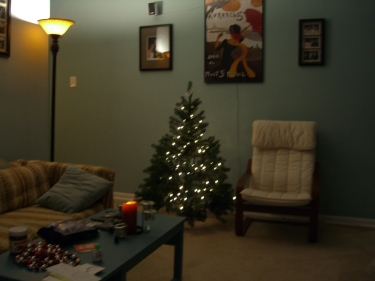
The Christmas tree went up early this year because it was stored in our creepy basement that must be avoided at all costs, since zombies live there. Since Mike had to venture down to put some stuff away, he decided to bring the tree up to save himself another life-threatening trip. Here it is, taking up too much space in our teeny living room.

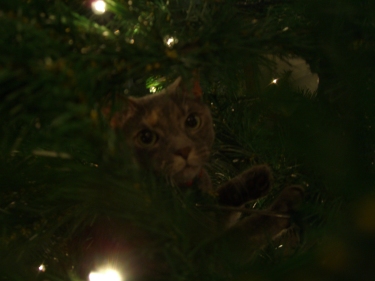
Immediately after the tree was placed in its stand, Alice PhD began investigating. For some reason, she thought the light bulbs smelled delicious and tried to eat them.

Here are Mike and I, shoving our faces full of spaghetti, swilling cheap wine, and being masters of our limited domain.

As I mentioned previously, the Death Cab show was unfortunately held at the Rostraver Ice Garden, which sucks in a number of ways. The acoustics are horrible, and you have to stand on ice covered by a thin carpet the entire time, meaning that numbness travels from your feet up your body as you stand there. A friend pointed out that the numbness wasn't so bad, as this was the first show she'd ever been to where her feet hadn't hurt the entire time. But they hurt twice as much later as they began to thaw. However, one great thing about the Ice Garden was the cheesy Disney movie-esque ambiance, which is represented by the sign in the above photo. Makes you want to rent The Mighty Ducks, doesn't it?

Another seemingly great thing about the Ice Garden was the time-out box and the enviable view it offered to short people like me. I watched Ted Leo's set and a fraction of Death Cab's from this spot, and it was temporarily glorious, as you can see from the picture below.

At this point, a raunchy echo developed that made it sound as if there were a drum-and-bass dance party being held in the back portion of the rink. My ass was asleep by then anyway, so we moved to the floor, which really wasn't that bad. People weren't obnoxious at all, which isn't something I can say about any show I've been to in the last few years, or possibly any show EVER. I'm usually, at some point during the show, stuck behind the tallest, fattest, smelliest guy in the room who dances wildly, beside teenage couples making out, and in the midst of an impromptu path between the stage and the bathroom and/or bar. But that didn't happen this time. Ted Leo was great, and Death Cab played every song I wanted to hear, so my $35 wasn't wasted (although it was DEFINITELY a rip-off).

So that was my Saturday. It wasn't amazing, but it was good, and that's more than I can usually ask for.

Friday, November 03, 2006

What the Business Professor Said.

As a person who is completely incompetent at any academic or professional field but the humanities, I've been guilty of sneering at business-y types who happen to have a more practical kind of knowledge. While these individuals, who understand mysterious real-world ideas like inflation and investment, are out there making tens of thousands of dollars more a year than I do (because their knowledge can, in fact, be used by corporations to make money), I watch my bank account dwindling and smugly think, "Well, at least I can understand texts and their cultural significance"--a skill that, unfortunately, has no cultural significance of its own these days. Which is why, sometimes, the business types can get under my skin.

All of this to provide background for my run-in with an unnamed business professor. This man teaches before me in the same classroom, and repeatedly breaks an unspoken academic code: he teaches for too long and then takes forever to pack up his laptop, Wall Street Journal, and other business-y accessories (it's almost like he's Business Ken or something). I was mildly annoyed for a while, but didn't really care: after all, I break codes of conduct on a pretty regular basis, advertantly or inadvertantly. So, aside from some occasional eye-rolling, I was tolerant.

Then, one day, he turned on me. I entered the classroom early with a student. Business Ken was packing up his laptop; I nodded hello and then ignored him. My student, a really nice, smart kid, asked me when I was going to return his last essay. I told him when, and we began comparing and contrasting the difficulties of grading papers with the difficulties of writing them. The student had a hard time believing that grading papers could be as difficult as writing them, and asked me what could be so hard about it. As I began to tell him that assigning grades was the most difficult part, Business Ken turned to me abruptly and began to tell me off. Rapidly and with great agitation, he condescendingly informed me that I only felt that way about grading because I was young and inexperienced, and that I had to learn to set and keep high standards whether my students met them or not.

I've never been any good at controlling my facial expressions, especially those produced by annoyance, surprise, and anger. Business Ken's unwanted lecture caused me to feel all of these things simultaneously, and I'm sure he knew it immediately. However, he continued his harangue, undaunted by my "die, bitch" expression. When he stopped to take a breath, Wall Street Journal and laptop securely in hand, I simply told him that he could ask my student (who had witnessed the lecture) about my standards. The student backed me up by confirming that they were quite tough, and Business Ken left the room.

As a vertitable infant on the teaching end of academia, I appreciate advice from experienced professors who are in my discipline and who know and respect me. I do not appreciate drive-by lectures by Business Ken, who has probably never graded a paper in his life. And I certainly do not enjoy being lectured in front of my students, whom I lecture (kinda) every other day. Luckily, my student agreed that Ken had stepped out of line. He laughed and remarked that Ken was probably trying to be fatherly, since I'm young (and look even younger). This made the situation even worse from my point of view, given my difficult past relationship with my own father. I could barely concentrate, and I had to somehow teach a class.

And so, I stumbled through my lesson plan for that day as I allowed Business Ken's voice to merge with the other hateful and demeaning voices already blaring (on a loop) in my brain. It took me all afternoon and evening to quiet the self-hating babble, which gave me a sick feeling in the pit of my stomach. Mike had to remind me (again) that those voices are telling lies, and (again) to stop being so fucking crazy. Thanks to his obstinate normalcy, the self-loathing induced nausea went away.

But the general feeling of self-hatred remained. It wasn't until Sunday, when I retreated to the chapel after the Hot Metal service, that I could ask for help--and be willing to receive it. I was reminded of Peter clamoring out of the boat when he saw Jesus strolling by on the sea that night--and sinking until Jesus convinced him to get the hell over himself. So, I decided to try to do that (getting over myself, that is) once again.

Tuesday, October 31, 2006

The "Mallier Kier's" moment of fame.


Yes, that was my car that you saw on the news, with the back window smashed and shards of very expensive glass covering the back seat.

And yes, that was me, surveying the scene in my pink polka-dotted pajamas, looking confused.

'nuff said.

Sunday, October 22, 2006

A 953-word review of "A 2,305-word essay on Sweet Child O' Mine."

The November issue of Paste arrived in our mailbox yesterday, and as I carried it into the house, the title of an article caught my eye: "A 2,305-word essay on Sweet Child O' Mine." Now, as far as titles go, this one would suck--if it weren't for the fact that it has most readers immediately wondering what one could possibly have to say about a Guns n' Roses song in an article that long. Falling prey to this curiosity myself, I flipped to the article and found that the previous title is actually only a subtitle/alternate. The full title of the article is "How a bunch of long-haired, strung-out guys in leather pants taught me about humankind's struggle to make sense of existence in a meaning-starved corner of the postmodern here and now, or: A 2,305-word essay on Sweet Child O' Mine."

The lure of this title, in its wordy glory, becomes a bit more complex once you've read the entire thing. It is clear that the article has a more specific audience than originally assumed. Allow me to point out a few key words: "or," "humankind's struggle," "existence," "postmodern." These signify that the author fancies himself not only a music critic, but a scholar in the field of cultural studies. He makes us aware that not only will he be analyzing a kitchy eighties song, but he will be doing so with intellectual panache, bringing together tidbits of history, philosophy, and literature. Obviously, this article is intended for people like himself who have united once-split loyalties to "high" and popular culture under the banner of postmodern pastiche.

Most of the time, I'm one of those people. As a student of literature, I also believe that I'm a student of culture, in all of its complexity. As a postmodern, I see no problem with analyzing a pop song as a literary work, because I think it IS a literary work. So, it seems that I'd really appreciate this article, and I do. But I don't LIKE it. I thought I did, at first, but the author lost me before I even finished the first page. Now I'm trying to identify why.

The purpose of the article is to trace the mounting tension between the opposing forces of bubble-gum pop and cultural uncertainty/disorder within the song. The author employs an analysis of lyrics and melody to argue that the song's feel-good romantic narrative is intentionally disrupted by a dark nihilism that threatens to become the dominant narrative of the song. By the song's close, however, the two narratives continue to exist side-by-side, forming a pastiche that comments on the dual nature of late capitalism: we embrace uncertainty and unbridled hope at the same moment. To make this argument, the author forms a pastiche of his own, juxtaposing his analysis with lines from Yeats' "Second Coming", Ezra Pound's "The Return," John Betjeman's "Slough," and Paul Simon lyrics.

Ok, so here's why I don't like this.

1. The author's need to identify himself as a postmodern is too self-conscious, and, in my opinion, hackneyed. Postmodernism (in its philosophical and literary forms) can be traced back to the late 1940s, making it sixty years old. But somehow, it's still treated as if it were a hip new phenomenon. I thought Christians were mainly guilty of this, but it appears that others (who should know better) are as well. Maybe this sounds smarmy, but seriously, pastiche is not a new idea. Neither is using literary form to comment on the message of a piece. SO MANY writers have done it now that it shouldn't really be attempted with a straight face anymore. This author seems a little too proud of himself for approprating a played-out literary mode.

2. Similarly, the author is obviously anxious to identify himself as one of the cool kids. First, he makes it clear that he did not like Guns n' Roses at the height of their fame. He likes them now that they've become kitchy and nostalgic (another pomo staple). Next, he takes pains to place himself within a subcultural elite: he understands diverse cononical literary works (Twain, Pound, Thomas, and especially Yeats), he knows "good" popular and obscure music, and he has a "cynical Marxist friend" (a prerequisite for belonging to the cultural studies elite). In short, the author seems so eager to prove himself to his readers that I almost felt sorry for him as I encountered posture after textual posture.

3. His prose is often over-indulgent. For example: "The whole imprecatory riot crescendos in an epic complaint that demands an answer it knows it will never get." Riiiight.

4. There's a big hole in his gaudy postmodern guise: his failure to be egalitarian. Only four women are mentioned in the entire article. Three of them are literary constructions: Becky Thatcher, "Sweet Child," and Little Suzy. The only female writer/artist mentioned is Cyndi Lauper, and then only to describe bracelets. The writers, philosophers, and musicians of importance to the author are dudes. This would be almost understandable (after all, we still live in a male-dominated culture) if he did not defend Axl Rose's mysogynist impulse when no defense is needed. Even if the woman in "Sweet Child" is objectified less violently or lewdly than in other Guns n' Roses songs, she's still being objectified and condescended to. The author's argument did not necessitate a defense of Axl's ideas about women; therefore, he should have left that part out and made himself more credible.

OK, so it's not easy to write 2,305 words about a Guns n' Roses song. But if you're going to do it, at least be a bit more aware of what you're getting yourself into.

Wednesday, October 11, 2006

Here's what the future holds for 36 lucky freshmen.

Instead of grading the intimidating stack of papers sitting on my desk, I'm thinking about the classes I'm going to teach next semester, particularly the readings I'm going to assign in those classes. This has distracted me all evening, so I feel the need to write about it.

First, here's why I'm thinking about my future classes instead of those I'm currently teaching. Unfortunately for me, I don't happen to be one of those (usually) contented individuals who "live in the present." Most days, from my point of view, the present sucks. But, lest I sound too pessimistic, it is also true that I generally count on the future to bail me out--even though the bailing out hardly ever happens when the future becomes the dreaded present, thus beginning the vicious cycle again. So, I'm thinking about the spring semester because it still exists in the future and is therefore infinitely more interesting and promising than the present. Four months from now I'll be writing a similar blog about fall '07.

So here's what I'm thinking about assigning.

Because I teach "Imaginative Literature and Critical Writing," an introductory literature course, I'm required to include the major literary genres: poetry, drama, and fiction. However, I do get to pick the subject matter for my classes, which means I can torture my students with the stuff that I love. Last time I taught this course, I decided to be gutsy and join the course cluster entitled "Oppression, Resistance, and Protest." I made my students read literature about how few rights individuals around the globe--particularly in America--actually have. Included were classics such as Miller's The Crucible and Steinbeck's The Pearl, but I also decided to take a few risks with Kushner's Angels in America and Guterson's Snow Falling on Cedars. The class turned out to be...interesting, especially since there were quite a few conservative political science majors in the class (dudes in love with their own voices, of course). I don't regret using that topic, but I think I'm going to be a bit more subtle this time.

But not too subtle: a bit of controversy and discomfort can be a good thing in the literature classroom. I think I'm going to start with a brief unit of creative non-fiction, which will definitely include David Sedaris (right now I'm thinking "i like guys" or "me talk pretty one day"), Annie Dillard (probably from An American Childhood), and a healthy dose of modernist expatriate memoirs. Then I may force them to explore the line between fiction and non-fiction with Capote's In Cold Blood. Of course, there will also be fiction by a handful of my favorite writers (John Updike, Flannery O'Connor, and Rosario Ferre, to name only a few). As for poetry, I think I'm going to take a leap and make them read some Eliot (maybe Prufrock? One of the Four Quartets?) but also some of the Victorians he hated, such as Christina Rossetti (Goblin Market?) and Robert Browning. Oh, and a few contemporary poets who pepper the generalist anthologies, for good measure. (Not to downplay the contemporary: I really do like some of it.) Finally, I think I'm going to bring back Angels in America because it's hilarious and forces them to see the world from a very different perspective (and it's set in the '80s, so I get to do my "I love the eighties" lecture). But I'm also thinking about adding Wit and A Doll's House, or maybe something by Tennessee Williams, since I'm preoccupied by Southern literature right now.

Anyway, this is the first time I've thought about the spring, so the list will definitely morph into something else by the time January comes. But brainstorming my future syllabus is SO MUCH better than grading papers that are currently cluttering up my present. And because the pile isn't exactly dwindling (I've been doing any number of unpleasant tasks to avoid it), you'll probably see another blog about future possibilities--in the classroom and out--posted here soon.

Friday, October 06, 2006

Everything's better in October. Even Pittsburgh.

Well, OK. Not everything. It's midterm in college land, which means the students are stressed and unhappy, which in turn means that my job kinda sucks right now. But a lot of things are better in this, my favorite month. The morning view from the 10th Street Bridge, in particular.

Three mornings a week I walk from the Southside to Duquesne, which means I have to cross the 10th Street Bridge, climb an intimidating set of steps, and cross the Boulevard of the Allies. The steps often make me curse DU's lofty location, but the bridge affords a notable view of downtown, the Southside, Oakland, and of course, the Mon. Because I cross the bridge so often, however, I began to ignore the view--until Monday, when the morning sunshine met the fog, producing spectacular results (that language would render ordinary, so I won't even try to describe them). I will, however, mention that I was reminded again, for the first time in a while, how oddly appealing Pittsburgh can be.

Fall glory unfolded again (in a distinctly Pittsburgh way) over the weekend when Mike and I hiked around the Southside slopes. It doesn't get any more Pittsburgh than the slopes, where sets of stairs are considered streets, old row houses are built into the hillside, and the downtown skyline can be viewed from the woods. We took the "church" route, which begins on 21st Street and winds around to Monastery and Pius streets, and shamelessly craned our necks over fences to check out houses we loved and their enviable views. The tree leaves were beginning to change, the air was crisp, and I experienced a rare moment of satisfaction with myself and the world. It was short-lived: while walking over a bridge, I looked down and noticed that the sidewalk was made of metal grating that provided a dizzying view of the 100-foot drop beneath. Immediately I imagined a snap of rusted metal and my body plummeting into the ravine below, where it would smash, pumpkin-like, into an unrecognizable mush of flesh. Ah, what a pleasant day.

Recently I've criticised myself for becoming one of those Pittsburghers who never leaves their neighborhood. But the Southside has basically everything I want and need: a movie theater, cheap European fashion (H & M), a grocery store, bookstores, a library, Crazy Mocha (a must!), and plenty of bars and restaurants. Oh, and enviable October vistas. So why should I leave?

Saturday, September 23, 2006

"This neighborhood is not a ghetto! We are not going to let them make it one!"

Or so a neighbor exclaimed to Mike after last night's incident.

Here's how it went down: I was awakened at about 3 am by the sound of shattering glass. My first thought was that our bedroom window, only inches from the sidewalk, had been broken by a baseball bat and that Mike and I would soon be bludgeoned to death by a thief--after he (or she) discovered that there's nothing of value to be found here. But as wakefulness quickly claimed me, I became aware that nothing quite that serious was happening. My next thought was that someone was breaking car windows, but when Mike peered outside, there was no one in sight. At that very moment, I heard yet another explosion of glass and discovered that the college kids across the street, drunk on a Friday night, were gathering just about everything breakable inside their apartment and hurling it onto the street--and sidewalk and cars--below.

Someone called the cops, who made the kids at least make a show of cleaning up the mess (even though they were way too drunk to hold a broom). Mike ventured out to see if our cars were still intact, and they were. While he was outside, he asked the cop what had happened. "They had a party, and now they're cleaning up," came the curt reply. But what kind of party involves throwing all of your fragile belonging out the window? Have I grown so old that I no longer understand what the hip kids do at parties these days?

Maybe this is my vanity talking, but I prefer to think that the kids across the street are spoiled rich dicks who've never had to think for themselves--only about themselves. And I'm not the only one who thinks so. Today, our neighbors expressed their disgust and anger at the lack of neighborliness the college kids have revealed on a regular basis. It seems that this isn't the first incident they've created: a few months ago they were partying loudly on a weeknight and the cops were called. One of the kids was so uncooperative that they had to load his ass into the paddy wagon and take him down to the station. Now, the adult residents of the 1700 block of Jane Street want to get them evicted.

I'm just as angry at the assholes as everyone else: I've got better things to do than clean a bunch of broken shit off my sidewalk, and I'd rather not have to buy new tires. But their anger runs deeper than that. My neighbor got at the heart of the issue when she declared that we must keep our neighborhood from becoming a ghetto. Because when you live in the city, it seems like "the ghetto," with its stereotypical barred and boarded windows, curbside trash, and graffiti, is constantly encroaching.

But this neighborhood has resisted decline. When I moved here from South Oakland two years ago, the surprising peace and quiet of our block, as well as its tidiness and friendliness, was like a gift. I had always thought of the Southside as a loud, active part of the city, but this particular neighborhood seemed to have a small town ambiance due to its largely middle-aged and elderly residents who had lived here for most of their lives. Because of their long-term commitment, our neighborhood remained virtually crime-free and relatively clean.

Then, a house was sold to a landlord type who converted it into apartments that were promptly rented by unruly male Duquesne students. They're the type (not uncommon at Duquesne) who dye their hair, go tanning, pass a football awkwardly in the middle of the street, listen to weird European Coldplay remixes, and wear white button-down shirts with designer jeans on a daily basis: an uncultured, frat-boy variety of the metrosexual that seems to have become more and more prevalent. Their presence in the neighborhood has been aggravating, because they don't seem to understand the unspoken rules of the place; instead, they're acting like they live on, say, Dawson St.

What's so ironic about the situation is that these kids are most likely from upper-middle class suburban families who would shudder at most urban neighborhoods and probably blame the lower classes and minorities for ruining previously gentrified areas. Now, their kids--raised to carry the torch of American priviledge--are the ones being accused of turning our neighborhood into a ghetto. Maybe it's because they've been brought up with the idea that all urban neighborhoods are ghettos anyway, so why bother to exercise personal responsibility there? The city can absorb their days of youthful excess, and by the time they move back to the suburbs, they will have learned how to take care of themselves and their stuff, leaving the neighborhood to the next generation of selfish, sloppy kids.

OK, I admit it: I'm indulging in a rant. To be honest, they haven't made our neighborhood a "ghetto" yet. But after living in Oakland, I know the fear of college students is a reasonable one. It is likely that as more houses are sold to absentee landlords, more irresponsible college kids will move in and trash the neighborhood, lowering property value. I clearly don't care about property value, but I do care about personal responsibility and maintaining a clean, safe neighborhood. And, as of right now, there's still a bunch of broken glass and pottery all over our street. So, I'm going to do something I've never done before (and never thought I'd ever do): I'm going to call the cops. Hopefully they'll bring the paddy wagon back--as a dramatic flourish.

Wednesday, September 13, 2006

The Skinny

Yes, I wear skinny jeans. No, I do not aspire to be like Nicole Richie, who is regularly seen looking skinny in her skinny jeans. I wear them, instead, for two reasons: One, I like fashion, and they are fashionable; and two, I've become skinny again, and I like to think I can pull them off.

In his latest film, Scoop (which I thought was moderately funny but also somewhat forced), Woody Allen, who restored himself to the big screen and reprises his role as himself, says "My anxiety is like aerobics." This quote aptly describes my own weight loss recently: I've worried and obsessed away four pounds and counting since the beginning of the fall semester three weeks ago. Take note, dieters: you can throw away your weight loss books. Simply become a comp 101 instructor, and you'll lose weight even while eating all the fatty foods you can find. Add a bit of chronic depression to the mix, and you're set.

I accidentally discovered this diet a few years ago when I entered grad school and my neuroticism reached new heights as my weight dropped to new lows. For a while, I didn't notice the weight loss, probably because the all-encompassing anxiety was a bit distracting. When I finally realized that all of my clothes were too big--and why--I was forced to accept the terrible irony that I will only look fabulous when I'm most miserable.

Last summer I got married and finished school, and in the face of newfound marital bliss and so few demands on my time, excess neuroticism faded for a while. And because I wasn't miserable, I stopped looking fabulous. Ten extra pounds snuck onto my frame, and I was so contented at the time that I didn't even care--I continued visiting Michael's Pizza Bar on $.50 pizza night and hoovering as much as I could.

Then, in April, I went to Florida, and something ruined my view of the idyllic beach that stretched before me: the sight of my gigantic, pasty, dimpled ass spilling out of my bathing suit in the bright sunshine. Oh, the horror, the horror. At first I doubted that it could even be mine; it seemed so alien, extraterrestrial even. I poked it a few times to make sure Mike's idea of a joke wasn't to attach a prosthetic ass while I slept. But it was definitely, horrifyingly mine.

Exercize happened, and the ass dwindled. Then, teaching happened, along with its accompanying stress and self-doubt, and now I'm back to the skinniness of misery.

And so, I wear skinny jeans. My fear of tapered pants (which began in the mid-nineties after I had seen pictures of myself in pegged jeans) has subsided, at least while I'm neurotic and miserable enough to stay skinny. Or until they go out of style.

Tuesday, September 05, 2006

No hairdresser, no glory

I want to sucker-punch the person (probably a man) who originated the phrase, "A woman's hair is her glory." Why this violent reaction to a Victorian quote that could be safely classified as quaint? Because while nobody says it anymore, it's perfectly obvious that most people still believe women should have glorious hair. And in order to have glorious hair, a woman must find a trustworthy hairdresser--a nearly impossible task if you're unwilling to spend more for a haircut than for a new pair of shoes.

If you were looking at the Mallia family album right now, you would notice that my hair changes a lot over the course of twenty or so years. You would also notice that none of the many hairstyles I adopted were ever glorious, although certain individuals may classify the mullet I had in kindergarten and again (accidentally) in eighth grade as such. There was no glory in my overprocessed spiral perm during the early nineties, or in the stringy faux-raven pseudo-goth 'do in the mid-nineties, or in the purple pixie cut from my early college days. And there's certainly no glory in the overgrown bob I've settled for now.

And yet, I continue to quest for glorious hair. Meaning, I quest for a trustworthy hairdresser, even though finding one seems more impossible than ever. Recently, my hair barely recovered from two disasterous visits to Phillip Pelusi. I went to a decent hairdresser in Oakland for a while, but her dislike of everything and everyone (which she verbalized in a continuous rant as she angrily chopped off my hair), although amusing at times, made me paranoid, because I knew she disliked me too. Not because there was anything to dislike about me in particular--I did nothing but nod in agreement during her rants--but because it was just her way.

I've thought about giving up on glorious hair and just letting it grow until I look like a hippie. But I dislike hippies, and I'm already accused of being one often enough due to the vegetarianism, pacifism, and ecological concern. For the sake of my own dignity, I need to do whatever I can to distance myself from these people, so in addition to disdaining communes and having an alergic fit every time I catch a whiff of patchouli, I will continue to have my hair "styled" by incompetent hairdressers who promise glory, but fail to free my hair from its decidedly unglorious genetic bonds.

Sunday, August 13, 2006

Frank's Eulogy

All the glory when He took our place,
But He took my shoulders, and He shook my face
and He takes and He takes and He takes

Sufjan Stevens
from "Casimir Pulaski Day"


Last fall I began thinking about death. Pretty often, actually. To the point where I truly believed that I
would--not could--die at any moment. When I came to this realization around mid-December, I noticed that I had been surrounding myself with death: Bright Eyes' I'm Wide Awake, It's Morning, Arcade Fire's Funeral, and Death Cab for Cutie's Plans--all overtly interested in death--had been in my cd player constantly. I'd been preparing for my Master's exam by reading the seventy-five or so works of literature that my professors had decided were "great," and coincidentally, most of them were about death, too. When I walked around my neighborhood, I often felt that some freak disaster was about to befall me: a seemingly innocent passerby would turn out to be mentally ill and push me off the Tenth Street Bridge; the driver of a tractor trailer passing me on Carson Street would suddenly lose consciousness, drive onto the sidewalk, and crush me beneath the trailer's bulk. At night, having survived another seemingly perilous day, I would lie in bed and tell God that I wasn't ready, that he would have to pick someone else this time, even while I knew that a person can't really tell God anything.

Well, he didn't pick me. But I wasn't off the hook. At 10:30 on an evening in late January, I had almost fallen alseep on the couch when my mom called and told me, in a terrible voice, that my father had died. He had massive heart attack, fell over, and turned blue, leaving her behind to figure out what to do next. And me, to try to quietly reinterpret my life.

A few days later, at the funeral, I read a eulogy for my father. I was told later that it had been perfect, recounting truths about his life, inciting laughter and tears, heartache and hope. But ever since I delivered it, I've been completely speechless about my father's death. Language, as Derrida liked to claim, has proved inadequate as a vehicle of self-expression. And so, my reinterpretation of life is largely inarticulate. I've been listening instead of speaking for what feels like the first time, and in my silence, I've come up with a better eulogy for my father. It's a collection of writings about death, fatherhood, and the blank terror that has gripped my consciousness during the last eight months. And it comes closest to telling the truth about the world as I see it now.

Sufjan Stevens, "Casimir Pulaski Day" (from Illinoise)
Li-Young Lee, "Mnemonic" (from Rose)
T.S. Eliot, "The Burial of the Dead" (from The Waste Land)
Anne Lamott, "O Noraht, Noraht" (from Plan B: Further Thoughts on Faith)
Death Cab for Cutie, "What Sarah Said" (from Plans)
Arcade Fire, "Neighborhood #4 (Seven Kettles)" (from Funeral)
U2, "Wake Up Dead Man" (from Pop)
Bright Eyes, "Poison Oak" (from I'm Wide Awake, It's Morning)


Wednesday, August 09, 2006

Gnarls Barkley says it best...

Here's my first blog. It's about being crazy, and in it I quote the Gnarls Barkley song by the same name. Hopefully this is of interest to you.

The more I find out about the fundamental chaos that underlies the universe, the more
I need to convince myself that it has nothing to do with me, that I am not, in fact, crazy. This is a difficult thing to do when everywhere I go, I am confronted by other individuals who seem pretty crazy to me. Or are they?

Take, for instance, the man I saw jogging at Charlotte Beach last week. It was my mom's birthday, and since I'm generally a thoughtless and ungrateful daughter, I decided to drive up to Rochester to celebrate with her. (You may wonder why my mom would want to celebrate her birthday with a daughter like that. I'm wondering the same thing, actually.) On the morning of her birthday, the temperature fell below ninety for the first time in a week, and we decided to take a walk along the pier. As the wind picked up, tossing polluted waves onto our feet and blowing our hair into our lipstick, a man jogged past us. He was middle-aged, of average height and weight, and was wearing a typical middle-aged man workout outfit: shorts a little too short, t-shirt a little too tight, and socks pulled up a little too high. I would have forgotten him immedietly and would by no means be describing him right now if, in the next moment, he hadn't transformed himself into a public spectacle. Ten feet in front of us, he stopped jogging, arranged himself into a fighting stance, and began doing what I can only presume to be his best Bruce Lee impersonation: lunging forward, he karate-chopped frantically for several seconds, then began kicking and punching the air in front of him as if it had offended him gravely. Then, satisfied with the ass-kicking he had given nothingness, he jogged on serenely. A few moments later, perhaps to prepare for the air's return attack, he dropped to the ground, propped his feet atop a short concrete wall, and began doing rapid push-ups.

As we cut a wide swath around him, I did the only thing that can be expected of a bystander at that moment: I laughed loudly, and now that I think back on it, almost delightedly. Because, if I'm going to be honest, I must admit that public displays of eccentricity do delight me, even if they're seemingly inconsequential to others. For instance, I saw a woman wearing teal gaucho pants trip and fall on her face on a streetcorner in Beaver Falls, PA, and I had a similar reaction. (Mostly because she was wearing those hideous gaucho pants. The combination of the pants and the falling was too much for me.)

After a lengthy set of push-ups, the man's face had turned an unnatural shade of red. My mom stopped laughing and expressed her worry that he might have a heart attack if he didn't give up his silly grudge against air resistance. She wished that he would stop running/doing pushups/karate-chopping. Because I'm not nearly as nice as her, and because I had already abstracted the man from any sort of reality I associated myself with (with includes mortality, apparently), I wanted him to keep going, mostly so I could keep laughing. I got my wish: he ran the length of the boardwalk, tore off his t-shirt in a frenzy, and began the routine all over again. By this time, most of the people at the park at that moment had noticed him and were staring in wide-eyed confusion. One older man, sitting quietly at a picnic table, his rotund figure refreshingly fitness-free, stared with an intensity that comes only from seeing someone a little too much like you--your age, your socio-economic group--losing their damn mind.

Mom and I left the park before the second round of aerobic kung-fu had been completed, and as we drove away, she forgot the man and thought about more pleasant things, like the delicious food she would consume that night at her birthday dinner. I continued thinking about the man who was so willing to exhibit his fitness mania to all who wished--or didn't wish--to see. I replayed the scene over and over in my mind, as if it were one of those irresistable disaster clips on ifilm, and chuckled contentedly to myself. Then, because it had been such a delightful scene to me, I decided it would be wrong of me not to share it with my husband. So I called him, and described the scene in great detail. That week, I related the story to every friend I hung out with. They all laughed, asked "Who does that?" just as I wanted them to, and agreed that the man was clearly crazy.

The hilarity died when I began analyzing my compulsion to tell everyone I knew about the fitness freak. I mean, it was a funny story, definitely, but funny enough to announce to a group of near-strangers at a friend's family picninc? I don't think so. In fact, those near-strangers may have found my obsession with craziness a little bit crazy. I realized, then, that my interest in the fitness freak was merely a sad, passive-aggressive attempt to assert my own sanity in a chaotic, crazy world. And in doing so, I threw myself headlong into the choas.

Or maybe it's just me. But does it matter whether the chaos approaches from within or without? When I look either way, it's there, in plain sight. Maybe I found that man in the park so funny because his mania was familiar to me: he was wearing my id on his shirtsleeve. I think Gnarls Barkley says it best:

Maybe I'm crazy
Maybe you're crazy
Maybe we're crazy
Probably